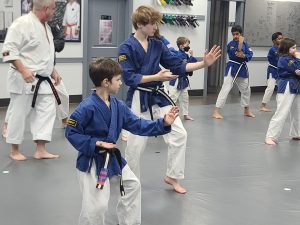
 Why Kata Is the Living History of Martial Arts
“Kata is not just a sequence of movements. It is a conversation with the past.”
Watch a student perform kata for the first time and you’ll see focus, effort, and maybe a little uncertainty. Watch a seasoned martial artist perform the same kata, and something else appears—rhythm, intention, and presence. The movements are the same, but the meaning is deeper. That’s because kata isn’t just practice. It’s preservation. It’s one of the most powerful ways martial arts holds onto its roots.
In a world that constantly pushes forward, kata pulls us back—back to the origin of techniques, the purpose behind movements, and the generations of practitioners who came before us. It’s easy to look at kata and see a routine. But if you look closer, you’ll realize it’s something much more important. It’s history in motion.
Kata Carries the Roots of the Art
Long before modern gyms, mats, and structured curriculums, martial arts were passed down person to person. There were no videos. No manuals. No step-by-step guides. What there was, however, were forms—structured sequences that encoded techniques, strategies, and principles into something that could be remembered and repeated.
That’s what kata is. It’s a living record of the art’s roots. Every movement exists for a reason. Every turn, block, and strike reflects lessons learned through real experience over time. When you perform kata, you’re not just practicing—you’re continuing a tradition that has been handed down for generations.
Understanding this changes how you train. Instead of rushing through a form to get it done, you begin to ask better questions. Why is this movement here? What does this transition represent? How would this apply in a real situation? That curiosity is what transforms kata from memorization into mastery.
More Than Movement—It’s Meaning
One of the biggest misconceptions about kata is that it’s just choreography. A pattern to follow. A checklist to complete for the next test. But kata was never meant to be empty movement. It was designed to teach principles—timing, distance, balance, and control—all within a structured format.
When students connect with the roots of kata, they begin to see those principles clearly. A simple block becomes a defensive strategy. A step becomes positioning. A sequence becomes a response to pressure. Suddenly, the form isn’t something you perform—it’s something you understand.
That understanding carries over into everything else. Sparring improves. Technique sharpens. Confidence grows. Because once you understand the “why” behind the movement, the “how” becomes much more natural.
Kata Builds Strong Foundations
In martial arts, flashy techniques come and go. But fundamentals last. Kata reinforces those fundamentals over and over again. It builds structure, balance, coordination, and awareness. It teaches you how to move with intention instead of reacting without control.
This is where the connection to roots becomes practical. The same principles that guided martial artists decades ago are still effective today. Strong stances. Clean transitions. Efficient movement. These aren’t outdated—they’re timeless.
When students commit to kata, they’re strengthening their foundation in a way that supports every other aspect of training. The stronger the foundation, the more advanced skills can be built on top of it.
Kata Develops Focus and Discipline
There’s a mental side to kata that often gets overlooked. Performing a form requires concentration. You have to remember the sequence, control your breathing, maintain your posture, and stay present from start to finish. That level of focus doesn’t happen by accident.
It’s developed through repetition. Through effort. Through patience.
And that’s where kata becomes more than just physical training. It becomes mental training. It teaches students to slow down, pay attention, and stay engaged. These habits don’t stay on the mat. They carry into school, work, and everyday life.
This is another reason why preserving the roots of kata matters. It’s not just about keeping tradition alive—it’s about maintaining a system that develops both body and mind.
Keeping the Art Alive
Every generation of martial artists has a choice. They can treat kata as something to “get through,” or they can treat it as something to preserve. When students understand the importance of kata, they take ownership of that responsibility.
They begin to see themselves not just as learners, but as carriers of the art. As people who will pass these movements—and the lessons behind them—on to others. That perspective builds pride. It builds connection. And it keeps the art alive.
Because without kata, martial arts loses part of its identity. It loses the thread that connects today’s students to the past. And without that connection, the art becomes incomplete.
Final Thoughts
Kata is not just a requirement. It’s not just something to memorize for testing. It is the living history of martial arts—a direct link to the roots that shaped the art into what it is today.
When you approach kata with intention, curiosity, and respect, your training changes. Your movements become sharper. Your understanding becomes deeper. And your connection to the art becomes stronger.
So the next time you step onto the mat and begin your kata, remember—you’re not just practicing. You’re continuing a story that started long before you. And now, you’re part of it.
click here:
The Importance of Katas in Martial Arts
The Parent’s Martial Arts Guide
Ultimate Anti-Bullying Program
-
Crabapplemartialarts.com and Crabapple Martial Arts Academy has been selected the nation’s #1 martial arts schools for SIX YEARS IN A ROW by the American Budokai International!
Founded in 2013 by Mr. C. Matthew White is a 5th-degree Black Belt in Karate and 6th-degree Black Belt in Jiu Jitsu, and Master Instructor. Crabapple Martial Arts Academy has Karate lessons for pre-school children to elementary kids ages 4 and up. These classes are designed to develop the critical building blocks kids need – specialized for each age group – for school excellence and later success in life.
Crabapple Martial Arts Adult Karate training is a complete adult fitness and conditioning program. This is for adults who want to lose weight, get (and stay) in shape, or learn self-defense in a supportive environment.
Instructors can answer questions or be contacted 24 hours a day, 7 days a week at of****@******************ts.com or call directly at 770-645-0930. You can also visit our website at CrabappleMartialArts.com.
About C. Matthew White, Shihan: Matt is a fifth-degree black belt in a traditional Japanese and Okinawan Martial Arts – Shuri Ryu Karatedo. He is also a sixth-degree black belt in Japanese Jiu Jitsu – Shintoyoshin Kai Jiu Jitsu. He is a master instructor with the title of Shihan, which means teacher of teachers in Japanese. Matt has a bachelor’s degree in Exercise and Sports Physiology. He has been training and teaching martial arts for over 27 years. He has owned Crabapple Martial Arts Academy since 2013. Shihan White is a motivational speaker and educator, who teaches seminars in bullying, business, and martial arts training.
Crabapple Martial Arts Academy Headquarters is in Alpharetta, Georgia at 12315 Crabapple Road., Suite 124, Alpharetta GA 30004. You can locate the Chief Instructor, Sensei Robert Reed there or directly at (770) 645-0930.